The Star Paradox: When Your Best Player Becomes Your Biggest Problem
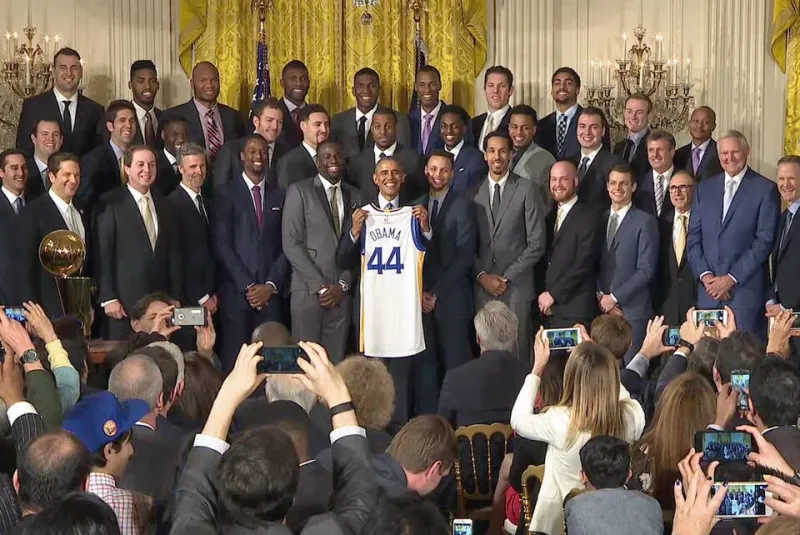
Photo: White House, Public domain, via Wikimedia Commons
There's a version of this story that plays out every few years in American sports, and it almost always gets told the same way. A franchise has a generational talent. The team builds around that talent. They spend years trying to surround the star with the right pieces. And then, somehow, inexplicably, the team performs better when that star is hurt, suspended, or — in the rarest cases — gone entirely.
It's not a knock on the player. It's not about effort or heart or desire to win. It's about something more complicated: how the presence of a dominant personality, even a brilliant one, can reshape a team's entire dynamic in ways that quietly limit everyone else.
The Gravity Problem
In basketball, they talk about "gravity" — the way elite scorers pull defenders toward them and theoretically open things up for teammates. In theory, having a player with maximum gravity is an advantage. In practice, it's more complicated than that.
When every defensive scheme is designed to stop one person, it can actually simplify the defense's job. Double teams become predictable. Rotations become automatic. Role players who might thrive in a more balanced attack find themselves standing in corners waiting for a pass that may never come, their development stalled because the offense doesn't need them to create anything.
Look at the years the Los Angeles Lakers surrounded Kobe Bryant with supporting casts that never quite fit. The ball-dominant nature of Kobe's game — which was genuinely spectacular — made it difficult to integrate players who needed touches to stay confident and rhythm to stay effective. Some players simply don't develop when they're scenery.
When the Step Back Becomes the Step Forward
One of the most interesting case studies in recent NBA history is what happened with the Golden State Warriors during Kevin Durant's tenure and the stretch after his departure. When Durant left, the conventional wisdom was that the Warriors were cooked. They'd lost the best player on the team. How do you replace that?
What actually happened — at least for stretches — was that the ball movement that defined the Warriors' dynasty before Durant re-emerged with more clarity. Steph Curry, already a generational talent himself, became the unquestioned focal point again, and the offense breathed differently. Role players got more defined responsibilities. The system reasserted itself.
This isn't a Durant critique — it's a chemistry observation. Sometimes the presence of a second alpha creates subtle friction that only becomes visible when it's gone.
The NFL Version of This Problem
In football, the star paradox shows up differently. Wide receivers who demand targets — even when that demand is implicit rather than stated — can quietly disrupt an offense's balance. Quarterbacks who need to be the guy in every situation can prevent offensive coordinators from deploying creative schemes that spread the ball around.
There's also the contract dimension. When a franchise commits massive cap space to one player, the roster construction around that player gets squeezed. You might have the best running back in the league, but if paying him means your offensive line is held together with duct tape and hope, you've created a structural problem that shows up as a third-quarter collapse in a January playoff game.
The teams that consistently compete in the NFL — your Chiefs, your Eagles in recent years — tend to have stars who exist within systems rather than systems that exist to serve stars. That's a subtle but enormous distinction.
The Chemistry Equation
There's a human element here that stats don't capture easily. When a team has one player who is clearly, undeniably the most important person in the building, it changes how everyone else relates to their own role. Some players thrive in that environment — they love having a clear hierarchy and defined responsibilities. Others quietly shrink.
The role player who might become a reliable scorer on a balanced team can spend three years as a catch-and-shoot specialist on a star-driven team, never developing the creation skills that would've made him more valuable. The young point guard who could grow into a decision-maker ends up deferring on every possession because the star wants the ball in the fourth quarter. Every fourth quarter.
None of this is malicious. Stars don't usually intend to limit their teammates' growth. But the gravitational pull of elite talent is real, and it reshapes everything around it — sometimes in ways that help, and sometimes in ways that quietly cost teams games they should've won.
The Teams That Figured It Out
The franchises that solve this equation are fascinating to watch. The San Antonio Spurs spent two decades threading this needle — building teams around Tim Duncan's dominance while also creating genuine roles for players like Manu Ginobili and Tony Parker, who weren't just supporting cast but actual co-creators of the offense.
The secret wasn't limiting Duncan. It was building a system where the star's gravity created real opportunities rather than just theoretical ones, and where the coaching staff actively developed everyone else's game regardless of their position in the hierarchy.
In the MLB, the teams that consistently produce results tend to have balanced offensive lineups rather than one transcendent bat surrounded by replacement-level hitters. The best lineup in baseball isn't the one with the best player — it's the one where every spot in the order is a genuine threat.
What This Means for How You Watch
Next time a team underperforms despite having obvious talent, resist the instinct to blame the role players. Ask instead whether the structure around the star is actually helping those players develop and contribute — or whether the gravitational pull is quietly pulling the whole system off balance.
The best teams in American sports aren't always the ones with the biggest star. They're the ones that figured out how to make the star and the system work in the same direction. That's harder than it sounds. And it's why some of the most talented rosters in sports history never won a thing.